
On 29 September 2026, the Prime Minister stated his intention to use the next UK-EU Summit (20 November) to lay out the ‘different options [...] for Britain’s long-term relationship’ with the EU.
In subsequent interviews, the Prime Minister suggested that options available to the UK included maintaining the status quo, negotiating a Customs Union, joining the Single Market, or going ‘all the way’ with EU membership. In response, the UK Trade and Business Commission (UKTBC) opened a business consultation into those four options.
Foreword
Lillian Jones MP, Chair of the UK Trade and Business Commission
On 20 November, leaders will meet for the second UK-EU Summit. The UKTBC supports the progress being made through these annual Summits and looks forward to assessing the final deals against the recommendations we have published in the last twelve months. The UK Government deserves real credit for the sustained diplomatic effort behind these agreements and the benefits they will bring for businesses and consumers.
Beyond the Summit, it is welcome that the Prime Minister has started a conversation about the long-term UK-EU relationship. Options that were off the table for years can now reenter the debate: a Customs Union, the Single Market, and even full membership. As a cross-party, cross-industry body, the UKTBC opened a consultation into each of those options – and the current approach – to ensure business’ voices were heard in that debate.
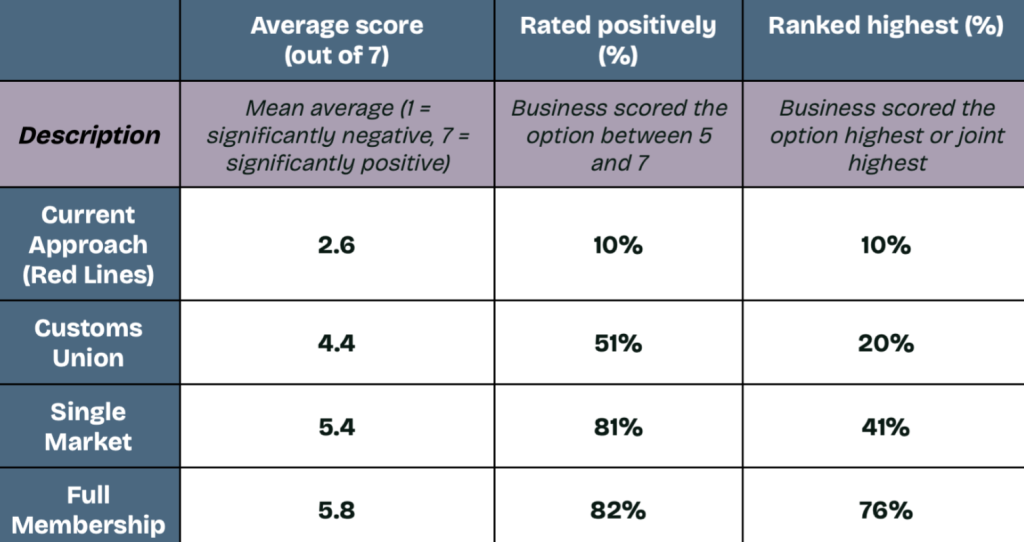
Nearly 150 businesses responded, and what they told us was striking. Just one in ten said the current approach to our relationship with the EU was having a positive impact. The closer the relationship being offered, the more positively businesses rated it. Four in five said that Single Market participation would have a positive impact, and the same proportion said so for full membership. Three-quarters rated membership the highest of the four options. A minority favoured current arrangements (10%) or a Customs Union (20%), and this report reflects their views too.
Behind those numbers are businesses for whom Brexit changed everything. A small craft store in Nottingham lost a third of their business overnight due to customs charges. A global fruit supplier in Kent can no longer export soft fruit which has a shelf life of days to the EU. In my constituency, a petfood company told us that exporting is now ‘not practical’, and a sports equipment manufacturer told us that freedom of movement would help them train and develop staff.
Some businesses are wary of the costs and uncertainty that could come with reopening the question. But continuing as we are also carries a heavy price. The UK Government has reset the tone of our relationship with our closest neighbours and begun to remove some existing barriers to trade. In this next phase, the UK Government must work with business on the economic and regulatory implications of more ambitious options, and show the political leadership to chart a path forward that will help deliver growth in every postcode.
Key findings
Businesses broadly welcomed efforts to reset relations with the EU, including the anticipated benefits of upcoming deals on agrifood (SPS), emissions trading (ETS) and youth experience (YES). Businesses expected the agreements to cut red tape at the border for impacted sectors, which in turn should ease pressure on prices for consumers downstream of them. The UKTBC finds that the UK-EU relationship reset provides a firm foundation for the next phase of the relationship.
However, it was clear that many businesses saw the current approach as insufficient for the scale of the challenges they face. Of all the available options, the status quo was the least popular: only 10% of businesses rated it positively. The UKTBC finds that the incrementalist approach of the reset is unsustainable in the long term. The UK Government should therefore drop its red lines on Europe (which rule out a Customs Union, joining the Single Market, or returning to freedom of movement).
Although a Customs Union would remove some barriers, most businesses said that major frictions would remain. Some raised concerns about the loss of UK independent tariff policy. 51% rated this option positively.
Businesses said that joining the Single Market would remove most barriers to trade, and 81% rated it positively. However, they said it could raise questions about the UK following EU rules without a formal say. Many felt this was a political judgment for the UK Government, rather than a question for industry.
Membership would combine the benefits of a Customs Union and the Single Market. 82% of businesses rated it positively, and 76% of businesses ranked it highest. It would guarantee access to EU programmes and funding. It would mean UK firms are included by default in new European preference rules. Businesses raised some concerns, including about the cost and feasibility, plus the need for a democratic mandate. They felt that again these were political questions outside their remit.
Aligning with EU rules, as required in Single Market and full EU membership scenarios, did not register as a top concern for business, in either goods or services.
As the UK Government explores the future UK-EU relationship, it should continue to engage business on the economic and regulatory implications of each option. However, every model for further integration raises political and constitutional questions, and businesses may be reluctant to weigh in on those issues.
Headline Results
Current Arrangements
The TCA is a zero-tariff, zero-quota agreement. Yet this has not prevented a sharp fall in UK goods exports to the EU. In 2025, they were 14% lower than 2019 levels in real terms. This can be attributed primarily to the persistence of non-tariff barriers. The UK-EU relationship reset should address some of these barriers. But the gains will be modest, as many regulatory goods barriers were not included on the agenda for UK-EU discussions.
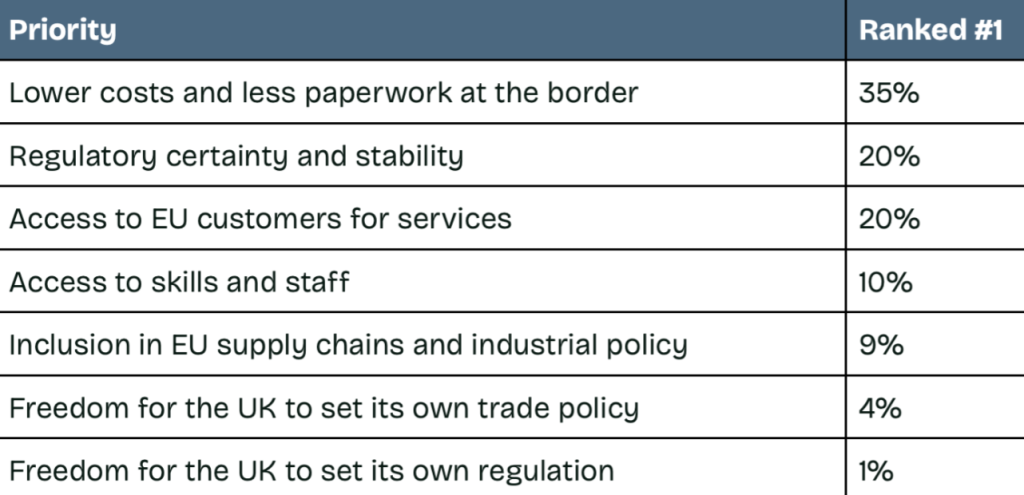
Businesses identified several barriers to goods trade that hamper their exports, such as the need to produce import and export declarations at the border, and the administrative burden and expense of customs checks and charges.
Priorities for the relationship moving forward
A Customs Union
A Customs Union would remove specific barriers to trade in goods. This would have some minor knock-on benefits for services exporters, especially in the digital and technology sectors, but major barriers to services trade would remain.
The Single Market
The EU Single Market rests on four freedoms: free movement of goods, services, people and capital. Joining the Single Market would therefore solve the majority of frictions to goods and services trade raised in the consultation.
Full membership
The full membership scenario combines the benefits of ‘the’ EU Customs Union (rather than ‘a’ new UK-EU Customs Union that would need to be negotiated) with entry into the Single Market. It would therefore resolve virtually all barriers that businesses identified in our consultation.
The UKTBC assessment is that membership removes nearly all barriers businesses raised in their consultation. It could provide certainty on a range of issues, from access to funding, to inclusion in EU-only initiatives such as ‘Made in Europe’. However, it was seen as the most ‘politicised’ of the options, and the UK Government would need to address industry’s political concerns which have knock-on impacts for business confidence.
Methodology
The consultation covered two areas. First, the UKTBC sought business views on the current state of the UK-EU trading relationship. This included the UK-EU Trade and Cooperation Agreement, which entered into force in 2021, as well as the UK Government’s approach since taking office (known as the UK-EU relationship reset). Since 2024, the UK Government has sought to improve UK-EU relations within a series of red lines that rule out membership of a Customs Union or the Single Market, or a return to freedom of movement.
Second, the UKTBC asked businesses to consider the options for deeper integration beyond those red lines and weigh the benefits, trade-offs, and risks of each. In representing their views, this report addresses several issues that frequently arise in the debate on UK-EU trade, including the UK’s freedom to negotiate its own trade agreements and its ability to regulate in its own interests. The report also reflects on the extent to which business can, and should, shape the conversation on the UK’s long-term relationship with the EU as it evolves.
The UKTBC received 145 responses to its online written consultation. Businesses were asked for their views on:
The current barriers impacting trade with the EU;
The impact that each relationship option would have on their business or members;
The barriers that each option would resolve, and those that would remain; and
Their key priorities and concerns should the long-term UK-EU relationship change.
Respondents were also asked to rate each option on a scale of 1 to 7, according to its likely impact on their business or members, where 1 meant ‘significantly negative’ and 7 meant ‘significantly positive’.
In addition, the UKTBC held two private roundtables under the Chatham House rule, one on goods and one on services, attended by around 20 business representative organisations and companies in total. Discussion followed the themes of the written consultation.
Finally, the UKTBC held a public evidence session on 12 November titled ‘Options for the UK-EU Long Term Relationship’. Witnesses Ian Bond (Centre for European Reform) and Professor Michael Gasiorek (Centre for Inclusive Trade Policy) gave evidence on the benefits, risks, and trade-offs associated with each option for deeper integration.