
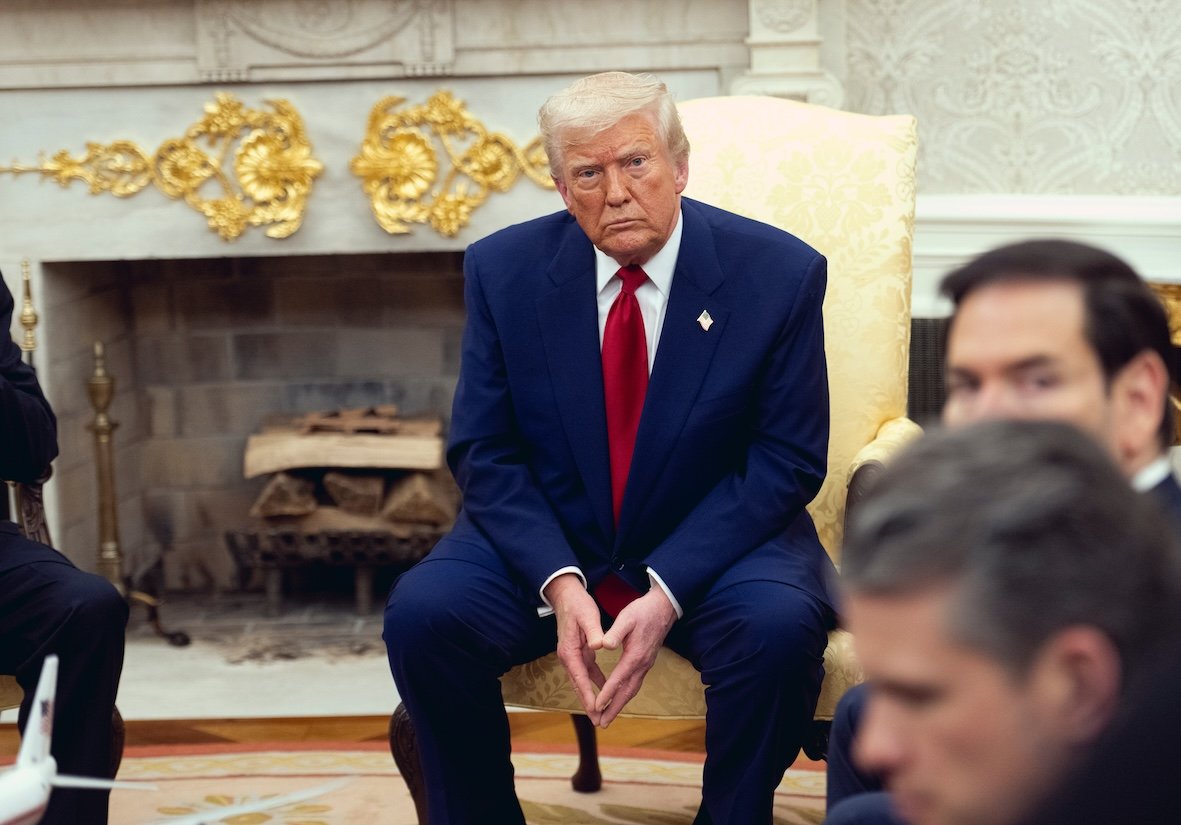
The United States has become “erratic” and "unreliable", and could even “be a threat to Europe”, experts including a former advisor to the then-Foreign Secretary have warned.
Speaking today at an evidence session of the cross-party UK Trade and Business Commission (UKTBC) on geopolitics, defence and security, former David Lammy advisor Ben Judah cautioned: “The superpower around which we have built our entire security has become erratic, unpredictable, unreliable and deeply emotional.”
Judah, a former Foreign, Commonwealth and Development Office (FCDO) special advisor, told the group of MPs and business leaders: “The United States in the 21st century is not the United States in the late 20th century.”
Trump, Judah argued, is “practicing foreign politics”, as opposed to foreign policy. He said: “[What] I believe we’ve seen over the Chagos Islands is the British right playing politics in Washington and Trump seeing himself as the leader of the global populist right - and engaging in foreign politics towards the Prime Minister.”
On defence spending, Judah warned that the impact of the oil crisis following the US-Israel war in Iran and the closure of the Straits of Hormuz risk there being “less money available for defence” - despite that “defence spending needs to go up and it needs to go up faster”.
While strategic studies Professor Phillips O’Brien, when asked about geopolitical developments changing the strategic incentives for closer UK-EU co-operation, starkly told the UKTBC: “We’re being too polite, in the way this question is being framed and the way we’re talking about it.
“There’s one great problem which is that the United States is no longer the United States upon which all European and British defence has been based for a generation. I would even go so far as to say that the US might be a threat to Europe right now and that needs to be faced.”
The University of St Andrews professor added: “It's not a transatlantic relationship problem, it's a transformation of the US from a security guaranteer to Europe to a threat to European liberal democracy.”
Speaking ahead of Mark Rutte’s NATO press conference this afternoon [March 26th], Professor O’Brien also sounded the alarm over the role of the North Atlantic Treaty Organisation (NATO) in safeguarding European security.
“It can't be NATO because NATO is a stalking horse for the US,” he stated. “There is a reasonable argument now that NATO is undermining European security... the need for change is drastic, I don’t believe it's being faced and I believe we are in trouble."
And Olivia O’Sullivan, Director of UK in the World Programme, at Chatham House, also emphasised significant concern over the US’ changing role on the world stage.
She said: “The US has now, it did before Trump but it is doing so much more urgently and abruptly, repeatedly signalled that it will - whether it does so gradually or it does so painfully - withdraw from its previous role in guaranteeing EU security.
“That has the strategic effect of weakening the deterrent effect of NATO because it undermines confidence in what the US would do if a NATO ally were compromised or attacked but it also leaves Europe practically exposed because of the role US defence capabilities play in European security.”
After the UK and the EU were so far unsuccessful in agreeing initial UK entry to the European SAFE defence fund, O’Sullivan also highlighted the “shared risk and a shared strategic interest” arguing: “It's imperative Europe spends more on defence and spends more to protect itself.”
The timely session took place as UK Prime Minister Sir Keir Starmer attended a key leaders’ gathering of the Joint Expeditionary Force (JEF) in Helsinki, Finland. Speaking to the media at the major European defence summit, Starmer told reporters that Western nations are facing “war on two fronts”, referencing the ongoing Russian invasion of Ukraine - and the US-Israel conflict with Iran. It also came as the UK announced British forces would begin seizing Russian shadow fleet tankers, in an effort to increase pressure on the Russian war economy.
While NATO chief Mark Rutte welcomed a hike in European and Canadian defence spending by 20% in 2025 compared to 2024 in real terms. He urged alliance members to step up further, arguing that a “strong transatlantic bond remains essential in an age of global uncertainty".