
Over three-quarters (76%) of businesses said the UK restoring its EU membership would have the most positive impact, or joint most positive impact, on them, consultation found,
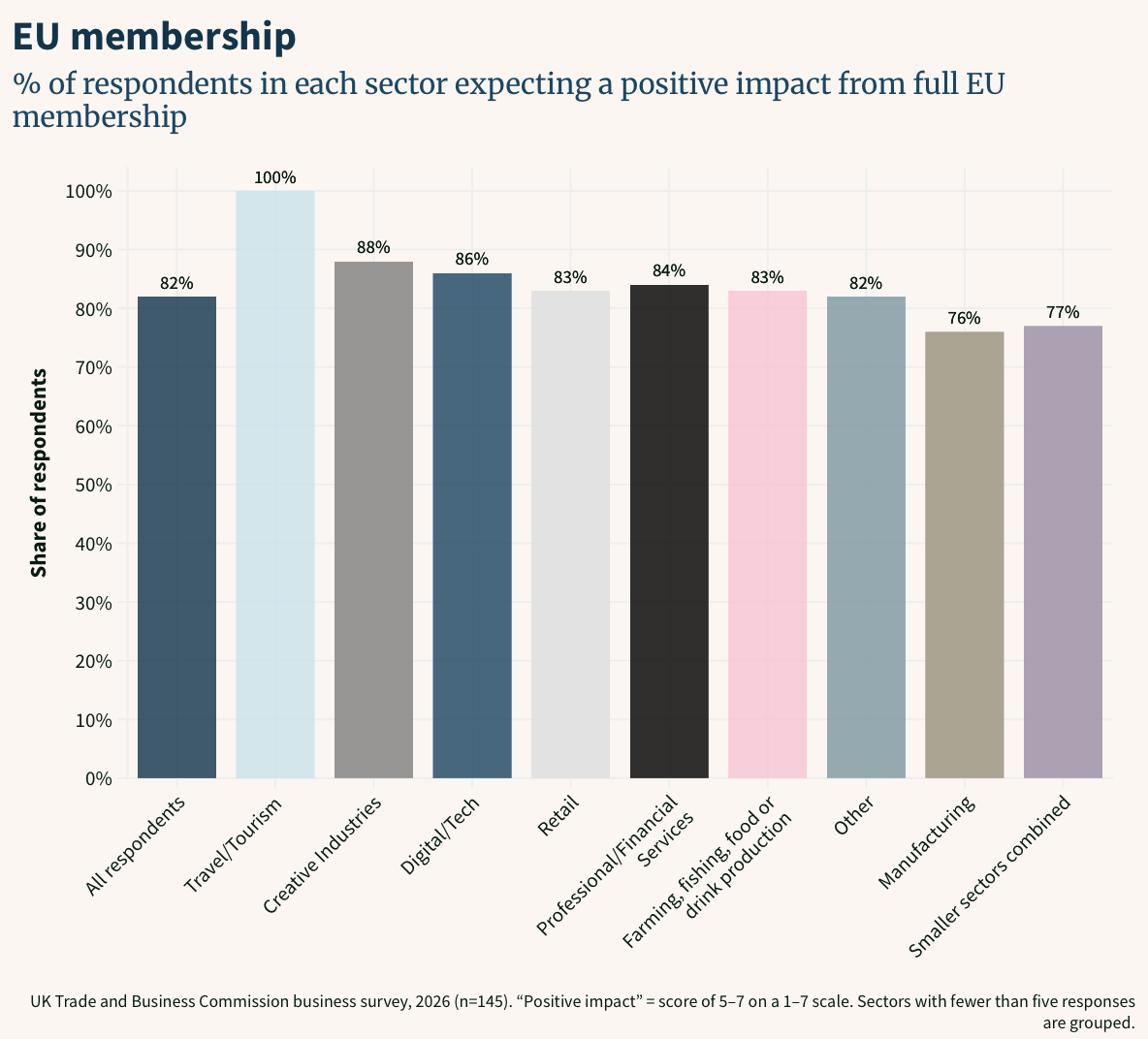
More than four in five firms (82%) said rejoining the EU would have a positive impact on their trading and operations, with 81% saying the same of joining the Single Market,
Firms welcomed efforts to reset relations with the EU, but many felt the current approach would not go far enough to address the issues they face, new UKTBC consultation reveals,
Business owners told the UKTBC rejoining the EU represented the “best outcome”, would see them “expand our growth” and would solve “all” the post-Brexit problems they face.
More than three-quarters of firms said the UK restoring its EU membership would have the most positive impact, or joint most positive impact, on their business, with over four out of five rating it positively, the findings of a new consultation from the UK Trade and Business Consultation (UKTBC) has revealed.
76% of businesses told the consultation, conducted by the cross-party, cross-industry UKTBC, that EU membership would have the most significant, or joint most significant, positive impact, by combining the benefits of joining the Customs Union and the Single Market. Businesses said it would guarantee access to EU programmes and funding, inclusion by default in new European preference rules, and a seat at the table in deciding how EU rules are set.
82% of companies consulted also rated the prospect of renewed EU membership positively, with the policy option scoring highest across both metrics, the consultation - which set out to establish what UK plc wants from the future of UK-EU relations, in the wake of the upcoming UK-EU summit.
Other key findings:
Businesses were broadly in favour of efforts to reset UK-EU relations, including on food and drink, emissions trading and youth mobility, but wanted improvements to go further,
Maintaining the current approach was the least popular option with just 10% of firms rating it positively, and the same amount ranking it as having the most positive impact,
The UKTBC is calling for the government to drop its ‘red lines’ on Europe: no return to the single market, customs union or freedom of movement,
Firms had reservations about a customs union and the single market, including the loss of independent UK tariff policy and the UK becoming a rule-taker without a seat at the table,
Reservations about full membership included the potential costs and political feasibility of such a change, though they felt that these strayed into political questions outside their remit.
The consultation, which ran from October 19 to November 6, 2026, was launched in response to Prime Minister Andy Burnham stating his intention to use the UK-EU Summit on November 20 to lay out “the different options for Britain’s long-term relationship with the EU”, and his comments to the BBC that the options available to the UK included “going all the way” with EU membership.
Businesses’ views were sought on the current state of the UK-EU trading relationship, including the UK-EU Trade and Cooperation Agreement which entered into force in 2021 and the sector deals being pursued under the UK-EU relationship reset. Firms were then asked to consider the options for deeper integration beyond the red lines, weighing the benefits, trade-offs and risks.
Overall, across the 145 responses received, companies stressed that their highest priorities moving forward were lower costs and less paperwork at the border, with 35% ranking this as their top priority. This was followed by regulatory certainty and stability and access to EU customers for services (jointly at 20% ranking it top priority). Freedom for the UK to set its own trade policy and regulation came bottom, at 4% and just 1% ranking them as their top priorities.
When asked to rank their key concerns for the UK-EU relationship moving forward, half (50%) of the firms who responded to the UKTBC consultation identified none of the issues as a concern. Of those who did flag a concern, half of these (25%) cited “costs and uncertainty during a transition”.
The consultation’s findings, presented in the report titled: ‘Options for Future UK-EU Relations: Business Consultation Findings’ are published by the UKTBC on Wednesday, November 18.
Lillian Jones, UKTBC chair and Labour MP for Kilmarnock and Loudoun, said:
“From local independent shops to major exporters, British businesses from across the country are faced with significant red tape and barriers when it comes to working with our European neighbours.
“With the summit days away, it is welcome that the Prime Minister intends to begin a national conversation about our future relationship with the EU, with all options back on the table. Businesses told us that the closer our relationship with Europe, the more positive the impact for their business. Any future relationship should address the priorities and barriers they have raised, to deliver growth in every postcode.”
Oliver Nicholls, Senior Policy Manager at Best for Britain, which provides the secretariat to the UKTBC, and lead author of the report, said:
“As countries around the world turn to tariffs and trade barriers to protect their industries, the UK cannot afford to go it alone. The UK-EU summit on Friday is a welcome step, but businesses need more than incremental change.
“Three-quarters of businesses who responded to our consultation told us that EU membership would have the most positive impact for their business. As the Government considers the options for our long-term relationship with the EU, it should listen to companies across the country who say that a more ambitious option would help them sell more, hire more staff, and invest in their local communities.”
Peter Norris, Virgin Group chair and member of the UKTBC, said:
“From the SMEs and sole traders, whose entrepreneurial spirit powers UK plc, all the way to the major corporations who drive forward our role in the global economy, it’s clear that far closer EU ties, including a conversation on membership, is now a crucial hygiene factor for success.
“Firms need access to the European-wide funding and programmes that can take them to the next level, and they deserve the UK to have a seat at the table in deciding how EU rules are set. They’ve made their voices heard: it’s now vital the government listens.”